The average piece of produce travels 1,300 miles before it reaches a grocery shelf. Somewhere along that journey, it passes through a refrigerated facility running around the clock: a cold storage warehouse, a distribution center, a ripening room. The equipment works. The controls do their job. Nobody wants to touch them.
That instinct makes sense. When your refrigeration goes down, so does everything in it. But “don’t touch what’s working” has a cost that shows up on your utility bill every month. Most facilities have no mechanism to manage it.
Demand charges. Fragmented visibility across a facility that never sleeps. Audit requirements that keep tightening. These aren’t problems you fix with a rip-and-replace upgrade. They’re problems you solve by layering intelligence on top of what you already have.
That’s what Airixa does.
The line item you’re probably not managing
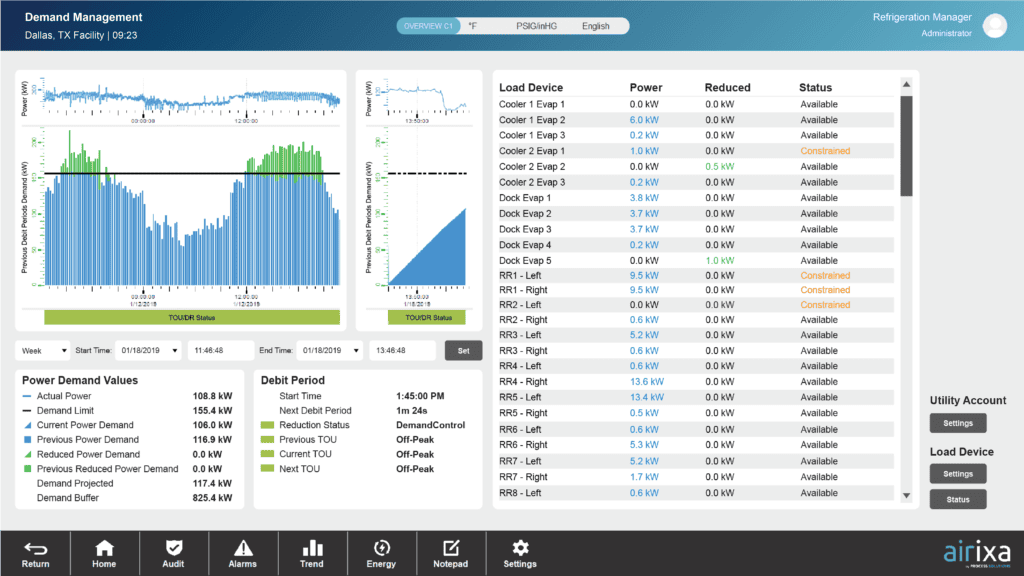
Your electricity bill has two components. The first is consumption: how many kilowatt-hours you used. The second is demand: the highest average kilowatt draw during any set interval in the billing period. That peak, even if it lasted 15 minutes at 2pm, sets your demand charge for the month.
Demand charges can account for 10–40% of your total utility bill. For a facility running large-scale refrigeration around the clock (compressors, evaporators, fans, pumps), those spikes aren’t anomalies. They’re predictable. They happen at startup, during defrost cycles, on hot days when condensers work harder, or can be attributed to processing equipment during periods of increased production.
Most refrigeration control systems aren’t built to manage this. They’re built to run equipment. They hold temperature setpoints, trigger defrost cycles, sequence compressors. What they don’t do is monitor your real-time kW draw, anticipate a demand spike, and shift load before it hits.
That gap is where Airixa operates.
Here’s how operations compare before and after adding Airixa to an existing refrigeration system:
| Operational dimension | Without Airixa | With Airixa |
|---|---|---|
| Energy demand management | No active load control; demand spikes drive up monthly charges | Intelligent load shifting and adaptive demand limits reduce utility bills 15–45% |
| System visibility | Equipment monitored individually, often panel by panel; no unified view | Single SCADA view of the full refrigeration system at plant and enterprise level |
| Remote access | On-site access only; off-hours issues require a call to the floor | Live system data available via browser and native iOS/Android apps from anywhere, 24/7 |
| Compliance and traceability | Manual logs; limited audit trail; difficult to satisfy FDA requirements | Automated FDA CFR 21 Part 11-compliant audit logs — every change timestamped and attributed |
| Scalability | Adding equipment requires re-engineering existing controls | Object-oriented architecture allows new equipment to be added without rebuilding the system |
How Airixa plugs into what you already have
“We knew we needed to design a system that could work with the facilities’ current and future equipment,” says Vaclav Mydlil, Senior Director of Energy Management and Refrigeration at Process Solutions. “At the same time, we needed to design it so we could easily scale without losing visibility at the plant level.”
What came out of that is an open-architecture platform built to run alongside what you already have, not replace it.
Airixa communicates with the equipment on your floor today. On the VFD side: Siemens, Rockwell, Schneider Electric, Yaskawa, Danfoss, and others. For compressor controllers: GEA-FES, Frick, Mycom, and other common makes. It also integrates with existing building management systems and ERP platforms. If your facility controls are already talking to other systems, Airixa joins that conversation without starting over.
After installation, the system scales without requiring a rebuild. Airixa’s object-oriented architecture means a new compressor, a cooler bay addition, or another ripening room gets added to the existing platform without touching what’s already running.
Energy savings that pay for the system
Airixa customers have reduced utility bills and demand charges by 15–45%. Where you land in that range depends on your starting point.
If your facility already has energy efficiency measures in place, expect savings in the 15% range. If you’re running refrigeration without any efficiency optimization, you’re looking at the higher end: conservatively 45% or more. Either way, the system pays for itself. After that, the savings go straight to the bottom line.
The mechanism isn’t a single lever. Airixa analyzes real-time environmental conditions and optimizes simultaneously across your refrigeration system: evaporator fan VFD speed, defrost cycle coordination, condenser floating discharge pressure, compressor staging and sequencing, and startup sequencing for energy-intensive equipment. Each one is a savings opportunity on its own. Running them together flattens the demand curve and cuts total consumption.
For US-based facilities, there’s also the demand response angle. Demand response programs, offered by utilities across the country, pay facilities to reduce or shift load during peak grid periods. Airixa monitors energy loads, automates load reduction, and enables participation in utility incentive programs. Many US companies that implement demand response generate additional revenue directly through rebates and incentives.
Full visibility, from the control room to your phone
Refrigeration doesn’t stop at 5pm. Which means your visibility into it can’t either.
Airixa includes a full SCADA package that gives you a single view of your entire refrigeration system, from both the plant and enterprise level. A system overview displays every piece of equipment graphically: compressors, evaporators, condensers, vessels. Click into any equipment tile and you get live trends, operational controls, active alarms, and current status. The actual data, not a summary.
For produce facilities with ripening rooms, Airixa adds dedicated dashboards for each room: temperature, CO2 levels, humidity, psychrometrics, refrigeration cycle data, and live product temperature trending. The conditions that determine whether produce hits the shelf at peak quality are all visible and controllable from one screen.
Airixa doesn’t assume you’ll be standing at the panel when something needs attention. It’s available via any web browser, plus native iOS and Android apps that push live data to any device. Multi-user authentication keeps access secure and permissions-based, so operators, managers, and remote engineers each see what they need to.
For regulated facilities, Airixa’s audit logs meet FDA CFR 21 Part 11 requirements. Every parameter change is timestamped and attributed: who changed it, from where, and when. That traceability is built into the SCADA package, not a separate add-on.
What your existing system can become
Your refrigeration system isn’t broken. But it’s probably costing more than it needs to, and it’s likely giving you less visibility than your operation demands. Those aren’t problems that require starting over — they’re problems Airixa was built to solve without disrupting what’s already working.
Airixa is running in facilities across North and South America today, controlling over 2,000,000 square feet of production space including 152 ripening rooms. The integration is proven. The energy savings are documented. You get the visibility on day one, not as a future upgrade.
If you’re managing refrigeration at scale and energy costs, visibility, or compliance are anywhere on your radar, the next step is straightforward.
Ready to see it in action? Contact Us and we’ll walk you through what Airixa looks like on a system like yours.
Want to learn more first? Visit the Airixa product page to see the full feature set, use cases, and how the platform is built.
Frequently asked questions
Does Airixa replace our existing PLC or work alongside it?
Airixa can work alongside your existing controls, or provide a comprehensive solution for your entire system. It’s an open-architecture platform that can control third-party equipment, so you don’t need to replace your current PLCs, VFDs, compressor controllers, or BMS to take advantage of it. Airixa connects to what you already have and adds energy management, SCADA visibility, and demand response on top.
How long does an Airixa installation take, and will it disrupt production?
Process Solutions pre-tests and simulates the full Airixa system using Siemens Software before any on-site work begins. That means commissioning at your facility uses a configuration that’s already been validated — reducing the window where active production could be affected. Contact Process Solutions for a timeline estimate based on your specific facility size and equipment.
What refrigeration equipment brands does Airixa work with?
On the VFD side: Siemens, Rockwell, Schneider Electric, Yaskawa, Danfoss, and others. For compressor controllers: GEA-FES, Frick, and Mycom, among others. Airixa also integrates with existing building management systems and ERP platforms. If your facility uses a mix of brands — which most do — Airixa is built to handle that without requiring you to standardize first.
How do I know if the energy savings will cover the cost of Airixa?
It depends on your starting point. Facilities with no existing energy efficiency measures typically see utility bill reductions of 45% or more. Facilities that have already made some efficiency investments still tend to see 15%+ savings. In most cases, those savings cover the cost of the system before most capital projects would even be approved. After that, the savings go straight to the bottom line. A conversation with Process Solutions can help you estimate where your facility sits in that range.
Can Airixa be expanded if we add equipment or new facility space?
Yes. Airixa uses an object-oriented software architecture, which means new equipment gets added to the existing platform without rebuilding what’s already running. A new compressor, an additional cooler bay, or another ripening room integrates into the system you already have. That matters for facilities that are expanding — you’re not starting over every time the footprint grows.